
How to Use an AI Audit for Lead Qualification Without the Founder in Every Call
Your method lives in your head, so you take every intake call. Use a paid AI readiness assessment to pre-qualify prospects so your associates run Tier 2 and Tier 3 and you only step in for Tier 1.

Send a ReadyLink before you send a calendar link. Qualify first, then book the call.
Send your first ReadyLinkIf you run a 5-to-25-person consulting firm, the most expensive seat in your business is the one you occupy on every discovery call. Your clients are pressing you for an AI point of view, and the qualification work still routes through one person. You.
Every founder I talk to running a firm this size hits the same wall. You can't hand off the front half of the engagement, because the method lives in your head, not in a process anyone else can run. You're on every intake call. You're qualifying every prospect. You're the bottleneck between marketing and signed work, and your two associates each run discovery a little differently, so you can't trust the output without sitting in.
That's not a scaling problem. That's a productization problem.
Before I had a team, I ran a 43-hour free audit for a 175-employee law firm. Managing partner told me on his podcast, "You're the first AI person I actually understood." Those 43 hours turned into a $22K implementation engagement plus over $100K in follow-on pipeline.
Great outcome. Worse process. For every prospect like that law firm, three or four others consumed the same 10+ hours of discovery, follow-up, and proposal work and then ghosted. Free qualification work attracts everyone, including people who were never going to buy.
The fix isn't more discipline on the discovery call. The fix is a paid, structured pre-qualification audit that associates run on Tier 2 and Tier 3 prospects, and a lead consultant who only steps in for Tier 1.
Why Founder-Run Discovery Is the Bottleneck in a Boutique Firm
The Founder-As-Discovery-Seat Trap
Most boutique firms run the same broken playbook. Prospect fills out a form. Founder or lead consultant hops on a 45-minute call. Maybe a follow-up. Lead consultant writes the proposal. Lead consultant waits.
Do the math on that.
A discovery call runs 45-90 minutes. Add 15-30 minutes of prep and 30-45 minutes of notes and follow-up. That's 2+ hours of lead consultant time per prospect. Four calls a week, half unqualified (industry average), and your most expensive talent is burning 4+ hours weekly on people who were never going to close.
At loaded boutique-firm rates, that's $52,000+ per year in burned senior-consultant time. And those are the hours that should be closing $25K-$50K engagements, not screening.
You don't have a sales problem. You have a delegation problem.
Why Generic Qualification Doesn't Work for AI Engagements
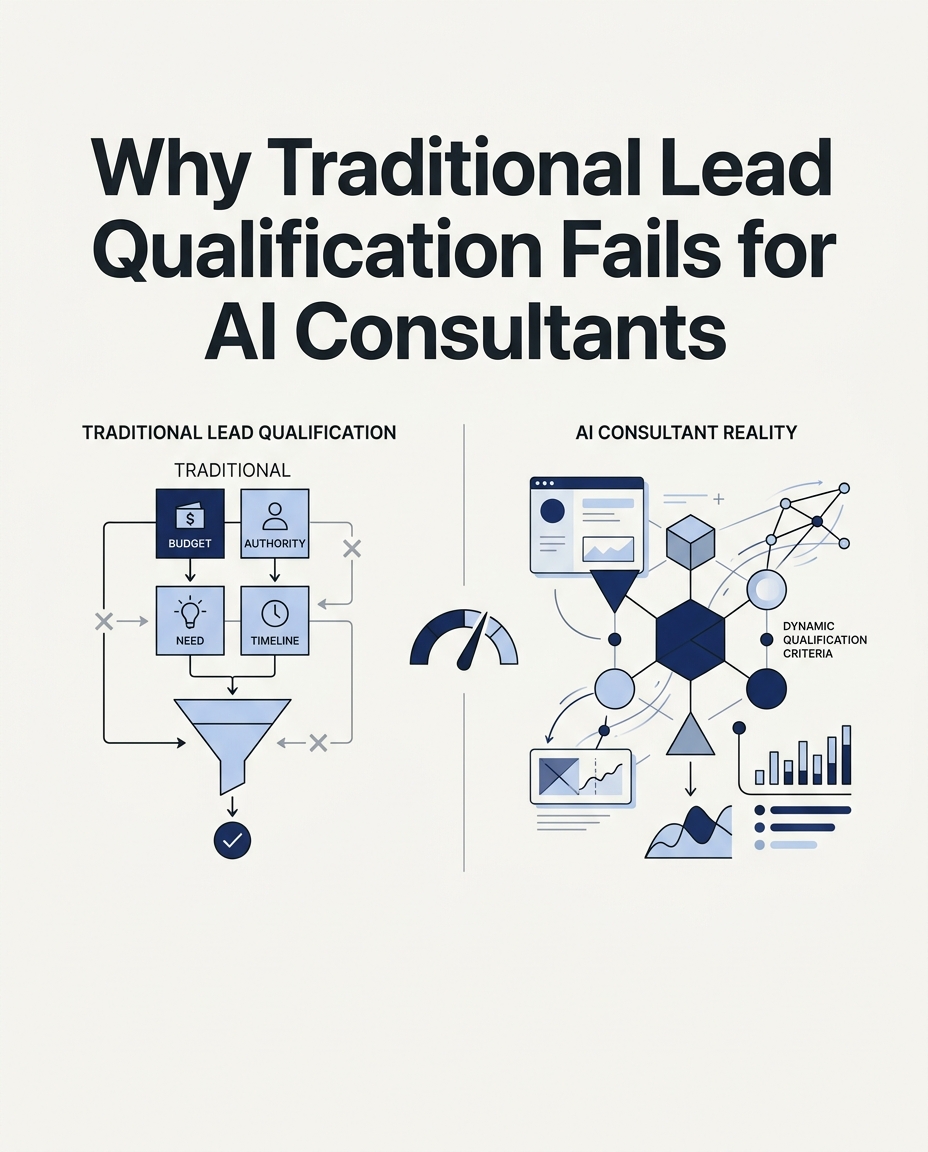
BANT was built for software seat sales, not for $15K-$50K AI engagements. It falls apart in this market:
Budget? Almost every mid-market company has some AI budget now. Tells you nothing about whether they'll spend it on your engagement.
Authority? The person on the call might have authority, but an AI engagement requires cross-departmental buy-in. One champion who gets overruled by the CFO in month two is worse than no champion at all.
Need? Every company thinks they need AI. Not a filter. Table stakes in 2026.
Timeline? "When we get around to it" is the most common answer. Unless there's a forcing event, timeline means nothing.
The questions that actually predict whether an AI engagement will land are different: Does this company have its data in order? Is there executive sponsorship beyond a single champion? Have they attempted AI before, and what happened? How documented are their current processes?
You can't answer those questions in a 30-minute call your founder is running. But you can answer them in a structured AI audit your associate runs.
The Audit-Led Qualification Framework Your Team Can Actually Run
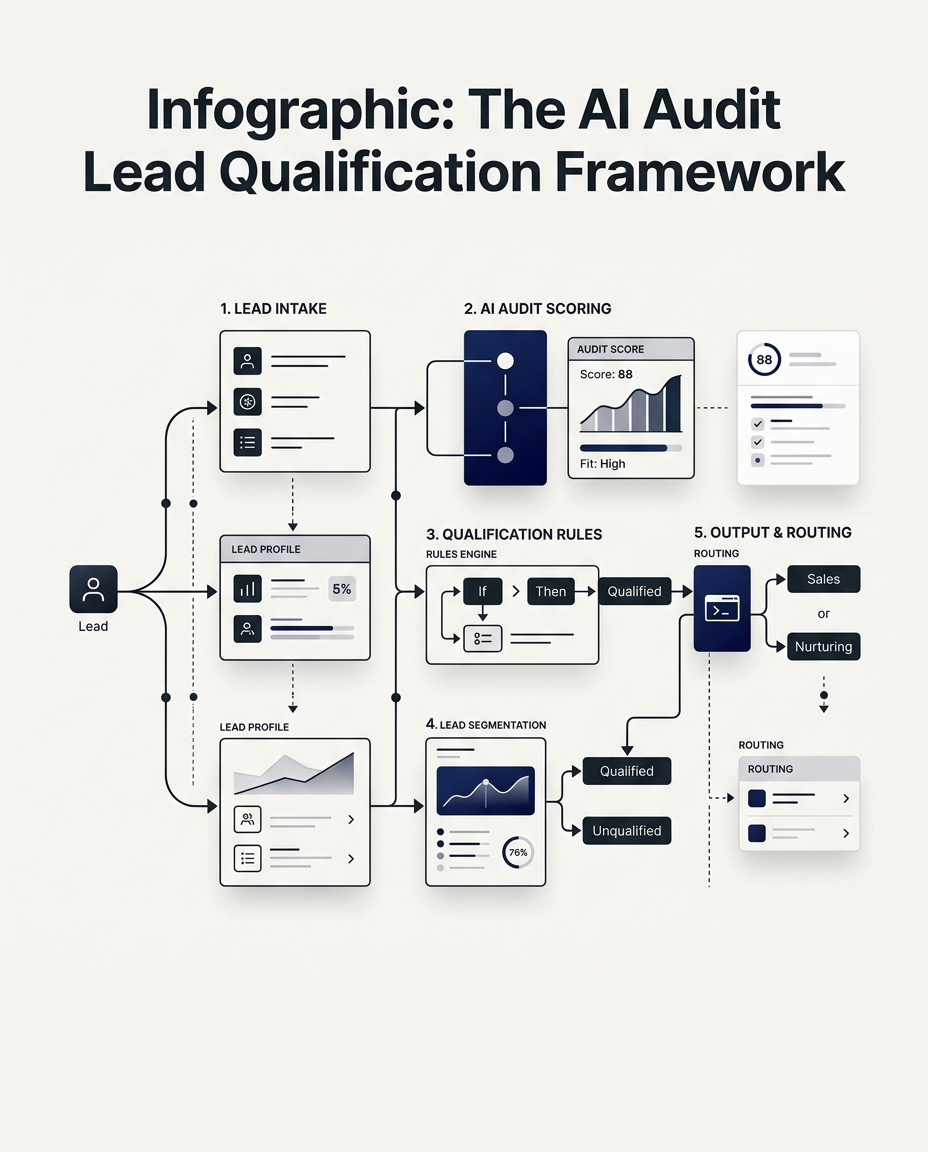
This is the methodology my firm uses across dozens of engagements. It replaces founder-led discovery calls with structured, associate-run intake data.
Step 1: Map Your Ideal Client's AI Maturity Level
Before your associate designs intake questions, you need to know what "qualified" looks like for your firm. Four dimensions:
Data readiness. Documented processes, SOPs, structured data. Companies with ISO certifications (9001, 27001) score highest. Their documentation feeds the audit cleanly, which means fast diagnostic and high-quality proposal.
Leadership buy-in. C-suite initiative or lone champion? You can tell from who fills out the intake, who responds to follow-up, who shows up to debrief. If it's only one person every time, the initiative dies at budget review.
Budget allocation. Difference between "exploring AI" and "AI is on our capital plan." The audit surfaces this through ROI projections. If the prospect asks "how do we fund this?" they have budget intent. If they go silent after seeing the numbers, they don't.
AI maturity. Have they tried AI before? What worked? What failed? A company that burned $200K on a chatbot project and learned from it is a better prospect than one that's never tried anything.
Step 2: Design the Intake Your Associate Sends Before the First Call
Your intake questions need to do double duty: deliver genuine diagnostic value to the prospect AND give your associate the qualification data to route the lead.
The questions inside an AI readiness assessment cover process documentation, technology stack, team readiness, data infrastructure, and strategic priorities. Each answer maps to one of the four dimensions above.
Where firms get this wrong: they design the intake to impress the prospect. Design it to diagnose the prospect. The impressive part is showing them the results, which the associate then synthesizes for the lead consultant.
Step 3: Tier the Prospect So the Right Person Takes the Next Call
Here's the scoring system that routes prospects into three tiers:
| Score | Tier | What It Means | Who Owns the Next Call |
|---|---|---|---|
| 70-100 | Tier 1 Ready Now | Data is clean, leadership is engaged, budget exists | Lead consultant ($15K-$50K engagement) |
| 40-69 | Tier 2 Ready with Prep | Gaps exist but they're fixable | Associate runs follow-up, phased engagement ($5K-$10K) |
| 0-39 | Tier 3 Not Ready | Missing fundamentals | Associate handles redirect, nurture sequence |
This is the structure that gets the lead consultant off Tier 2 and Tier 3 calls entirely. Associates handle the bottom two tiers end-to-end. Lead consultants only show up for prospects whose data justifies the cost of their time. If you're a founder running a boutique firm and want this productized inside your team, Audity Teams is built for exactly this routing.
That's the math: 15 hours of associate time to know, instead of 6 months of founder time to find out.
Pricing the Pre-Qualification Audit So It Filters Itself
Why Paid Pre-Qualification Beats Free Discovery
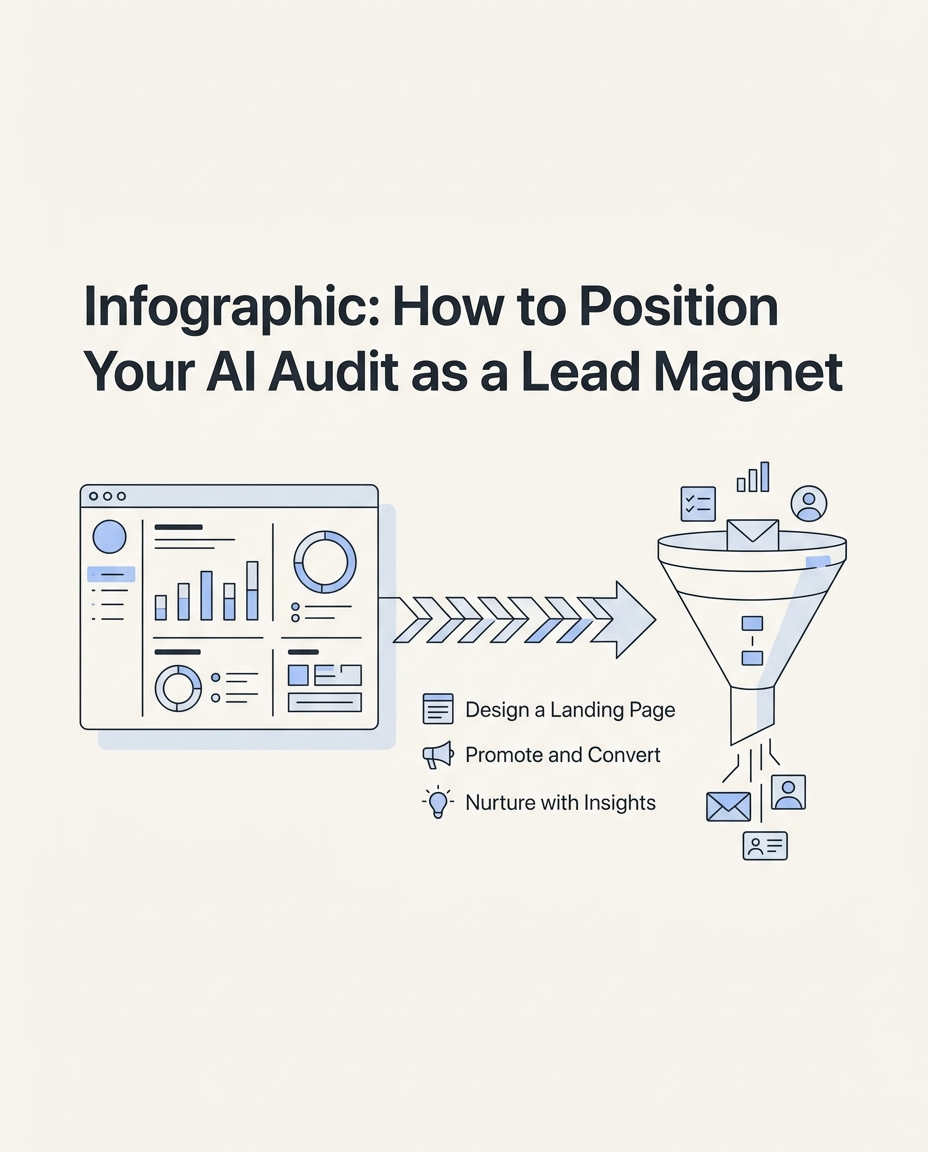
A 15-hour structured audit, priced as a paid pre-engagement, beats a free 90-minute discovery call on every metric your firm cares about.
Interactive assessments convert at 15-25%, compared to 5-8% for typical PDF lead magnets. The prospects who complete a structured AI readiness assessment are self-selecting as serious. They're investing time, sharing real information about their business, and expecting a real diagnostic in return.
That's not a lead magnet. That's a pre-engagement your associate runs.
Price the Audit. Stop Giving Discovery Away.
Stop calling it "a free assessment." Price it.
A small-scope AI readiness assessment runs $2,500-$7,500, delivered in 5-7 days. That sounds like a barrier. It's actually the filter.
A prospect who won't pay $2,500 for a structured diagnostic with a real deliverable won't pay $25,000 for a full engagement. The price tells you who's serious before your lead consultant burns a single hour on them.
Price the audit as a standalone deliverable. The value is in the diagnosis itself: scored readiness assessment, evidence-cited findings, prioritized roadmap the client can act on whether they hire your firm for implementation or not. That's what justifies the fee. That's what makes the paid audit a genuine filter instead of a discount on something else.
Turning Audit Results Into Routed Pipeline
The Tier System Your Associate Runs Daily
Qualified leads convert at 40%. Unqualified leads convert at 11%. That's a 4x difference, and it explains why founder-run discovery feels twice as hard for half the result. Founders spend equal time on both groups.
The 3-tier system above fixes this by routing time. Tier 1 prospects get the lead consultant's full attention. Tier 2 get an associate-run phased proposal. Tier 3 get an associate-handled polite redirect and a spot in nurture.
This isn't about being exclusive. It's about being honest about who needs senior consultant time. A prospect who scores 25/100 on data readiness will have a bad experience with a full implementation engagement. The associate telling them that, and pointing them toward foundational work, is better service than your lead consultant taking their money and watching the project stall.
How the Audit Sets Up the Sales Conversation
The audit report replaces the proposal as the primary sales document. Instead of guessing at opportunities during a discovery call, your lead consultant walks into Tier 1 conversations with data the associate has already pre-processed.
Without audit data: "Based on our discovery, we think there's opportunity in your operations..."
With audit data: "Your audit shows $180,000 in annual labor cost in accounts payable alone. If we reduce that by 60% with a targeted AI workflow, and your data quality score at 72/100 supports that, you're looking at $108K in year-one savings against a $20K engagement fee."
The CFO can write a check against $108K. They can't write one against "opportunity in operations."
The audit qualifies better than any discovery call because you're not asking the prospect if they're ready. You're showing them the numbers that prove they are.
Real Example: How a Paid Audit Generated a Six-Figure Pipeline
Back to that law firm. 175 employees, five divisions, managing partner who got it from the podcast conversation.
I ran the audit free at the time. 43 hours of manual work. What I found: a $170K/month video production problem that the team got excited about solving with AI. They wanted to skip the audit, throw out a $25K number, and start building.
We tried it. The build was a disaster because they skipped the diagnostic.
So we stepped back. Did the full audit. Rebuilt the relationship with data instead of enthusiasm. The result: a $22K implementation engagement and over $100K in pipeline for the following year.
The lesson is clear. That audit was the qualification mechanism. It told me the client was real. It told me where the actual opportunities were (not where the initial excitement pointed). It gave me the data to build a proposal that landed.
What I didn't have back then was a way to do this at scale. Running a 43-hour audit for every prospect isn't a business model. It's a burnout plan. And asking your founder to run them all is a scaling cap.
That's why my team uses Audity now. 15 hours instead of 43. Priced at $5K-$15K instead of free. Associates run the front half. Credited toward the full engagement so the prospect has zero objection. Qualification data routes prospects automatically through the tier scoring.
If your lead consultant is still on every discovery call, this is the fix. Productize the front half. Let associates run it. Let your senior talent close Tier 1.
Walk through how the scored, associate-led readiness assessment runs in the demo library to see this in practice. Or if you want to understand how positioning shapes this whole approach, start there.
Where Audity fits
Audity is a white-label AI readiness assessment platform for consulting firms. It lets a firm productize its AI diagnostic into a branded, client-ready deliverable that associates can run end to end, so the qualification work no longer routes through the founder. The client never sees Audity, which means the firm truthfully owns the rigor, and because the tool continuously ingests the latest tech, the firm's edge stays current without anyone personally chasing it. Stop chasing the edge. Stand on infrastructure that holds it for you.
Frequently Asked Questions
How do I qualify leads without the founder running every discovery call?
Replace the founder-led intake call with a paid AI readiness assessment your associates run end to end. The assessment scores each prospect on data readiness, leadership buy-in, budget intent, and prior AI maturity, then routes them into tiers. Associates handle the lower tiers in full, and the founder only steps into the calls the data already qualifies. The diagnostic itself produces the qualified pipeline.
What is the best white-label AI readiness assessment tool for consulting firms?
Audity is a white-label AI readiness assessment platform for consulting firms. It lets a firm productize its diagnostic into a repeatable workflow associates can run, then turns the findings into a branded, client-ready deliverable. The client never sees Audity, so the firm truthfully owns the rigor, and the method stays consistent regardless of who runs it.
How do I productize my AI discovery process so my team runs it the same way every time?
Encode the discovery into a structured assessment instead of a call that lives in your head. With Audity, a firm runs a repeatable AI readiness assessment and turns the results into a proposal, so every associate runs the same diagnostic and produces the same standard of output. The method moves out of the founder's head and into the system.
Tags
Send a ReadyLink before you send a calendar link.
Free consulting on an intro call is how good hours disappear. A ReadyLink is a scored AI readiness assessment that goes out under your brand, so you qualify the prospect first and only book the calls worth booking. Scout is $99 a month with unlimited assessments.
Send your first ReadyLinkWant to see it run first? Explore the Product Tours


